
The Anthropocene: The Debated Age of Humans
What is the Anthropocene?
The Anthropocene, from the Greek word “anthropos” (human) and “cene” (new), broadly refers to a new geological epoch (age) widely influenced by human activity (Pavid). Made popular in 2000 by scientists Eugene Stormer and Paul Crutzen, the new epoch refers to the unprecedented effect humans have had on the planet in the past few hundred years: global warming, nuclear weapons in the 1900s, and resource extraction (Anthropocene). Yet, beneath this definition lies a deeper debate on how and when to formally define our current epoch as the Age of Humans. How do we, as humans, place ourselves within the timeline of the natural world?
Even in defining the beginning of the Anthropocene, scientists have not reached a consensus, with some geologists tracing its origins to the Atomic Age and other scientists to the Industrial Revolution or the Agricultural Revolution (Pavid). The Geological Anthropocene is a proposed era of planetary history characterized by changes in rock layers that occur over long periods of time and are visible globally. However, it is hard to define presently, because geological changes occur over thousands of years (Moore). Geologists on the International Commission of Stratigraphy rejected the declaration of the Anthropocene epoch in 2024 due to unease about including a new epoch with a much shorter time span (Carrington).
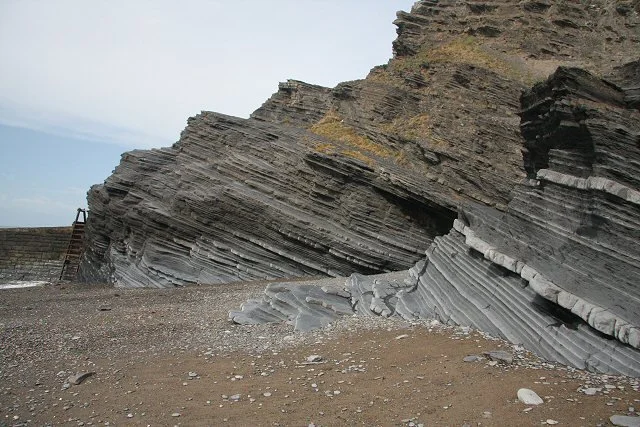
Jones, Bob. Tilted rock strata. 30 Mar. 2008. Geograph, https://www.geograph.org.uk/photo/744848. Accessed 1 Dec. 2025.
The cultural significance of the Age of Humans is, nonetheless, powerful. The Popular Anthropocene interprets the Age of Humans as the living narrative of the modern anthropogenic ecological crisis (Gibbard et al.). Given the increasing harm humans have made, the Popular Anthropocene forces us to ask: what should be the relation humans have to the environment? What are the alternatives to our current anthropocentric systems? How can the media shape the culture of the Anthropocene?
Human Exceptionalism
At the heart of the Anthropocene debate is human exceptionalism, or anthropocentrism, which is the view that humans are entirely separate from nature. This view was accelerated by European Enlightenment ideas and early Christian theology. These beliefs held that humans were created in the image of God, and human reasoning led people to believe that they were superior to evolution. Anthropocentrism views culture as the differentiator between humans and the environment (Kim et al.). By possessing culture, humans have believed they are not subject to the same evolutionary limitations as other species, fueling the belief in human superiority (Kim et al.). Anthropocentrism implies that while humanity can transform the planet, nature cannot impact humans in the same manner.
Human exceptionalism also silently powers much of today’s environmental action. Modern climate change is a human-caused phenomenon, so humans have the responsibility of mitigating it. However, climate change is often viewed as avoidable through economic methodologies centered on maintaining consumptive conditions rather than repairing environmental destruction. Frameworks currently employed to mitigate climate change often reinforce the human-centered view we need to overcome, only perpetuating human exceptionalism.
Alternatives to the Anthropocene
There are many alternatives to the Anthropocene, different on the basis of who is responsible for contemporary environmental degradation and when changes occurred. As “anthropos” refers to humans, the Anthropocene has been criticized for naming all humans as responsible for recent climate changes and viewing humans as separate from nature. Climate change, on the other hand, is the result of a few individuals and corporations in Western countries (Mathews). Thus, the Anthropocene overlooks Indigenous and non-Western relationships with the environment (Mathews), and over 80 alternative names have been proposed as a result (Chwałczyk).
Capitalocene, for example, names the economic system of capitalism as responsible for anthropogenic climate change instead of all of humanity, reflecting the prioritization of economic growth and production over environmental health (Moore). Other alternatives include the Wasteocene, an epoch defined by our systems of waste management that disproportionately affect marginalized groups (Armiero). These alternate epochs challenge the Anthropocene and offer a new perspective on the impact of human activity, developing frameworks to name exploitative systems as responsible for environmental changes.
Artistic Representations of the Anthropocene
Artists have sought to challenge this human-centered view through photography, film, and poetry, among other art forms. Photographic projects show the temporality of the Anthropocene through journalistic approaches and archival research. The Cantor Arts Center’s exhibition Second Nature: Photography in the Age of the Anthropocene unites 44 photographers from across six contents. The collection showcases the range of human impact on our planet: from rising sea waters to the disruptive legacy of forced climate migration. Similarly, Edward Burtynsky’s Lithium Mines #1 depicts an aerial view of the lithium mining installation in Chile’s Atacama Desert. The aerial perspective reveals enormous evaporation pools, each adorned with different shades of blue, green, or yellow that indicate its stage of evaporation (Esposito). This piece portrays the overlooked impacts of lithium mining, which devastate local livelihoods and environmental health.
Moving Beyond the Anthropocene
Although the Anthropocene failed to be recognized as a geological epoch, the concept reflects social and cultural changes in relation to the environment. Moving beyond the Age of Humans does not mean erasing the role of humans, but reforming extractive systems to live in relation to nature.
Debate about the Anthropocene and how to name the epoch reflects the interplay of science and environmental justice and how humans tell the history of anthropogenic climate change.
Works Cited
“Anthropocene - Capitalocene - Chthulucene.” CourseCompendium, narrative-environments.github.io/CourseCompendium/Anthropocene-Capitalocene-Chthulucene.html. Accessed 23 Nov. 2025.
“Anthropocene.” Education, education.nationalgeographic.org/resource/anthropocene/. Accessed 23 Nov. 2025.
Armiero, Marco. “The case for the wasteocene.” Environmental History, vol. 26, no. 3, 1 July 2021, pp. 425–430, https://doi.org/10.1093/envhis/emab014.003.
Carrington, Damian. “Geologists Reject Declaration of Anthropocene Epoch.” The Guardian, Guardian News and Media, 22 Mar. 2024, www.theguardian.com/science/2024/mar/22/geologists-reject-declaration-of-anthropocene-epoch.
Chwałczyk, Franciszek. “Around the anthropocene in eighty names—considering the urbanocene proposition.” Sustainability, vol. 12, no. 11, 31 May 2020, p. 4458, https://doi.org/10.3390/su12114458.
Esposito, Veronica. “‘Human Activity on a Massive Scale’: A Photo Exhibition Tackles the Climate Crisis.” The Guardian, Guardian News and Media, 26 Feb. 2025, www.theguardian.com/artanddesign/2025/feb/26/second-nature-exhibition-anthropocene-photography.
Gibbard, Philip, et al. “The Anthropocene as an Event, not an Epoch.” Journal of Quaternary Science, vol. 37, no. 3, 9 Mar. 2022, pp. 395–399, https://doi.org/10.1002/jqs.3416.
Jasanoff, Sheila. “Humility in the Anthropocene.” Globalizations, vol. 18, no. 6, 9 Feb. 2021, pp. 839–853, https://doi.org/10.1080/14747731.2020.1859743.
Kim, Joan J., et al. “Conceptualizing Human–Nature Relationships: Implications of Human Exceptionalist Thinking for Sustainability and Conservation.” Topics in Cognitive Science, vol. 15, no. 3, 22 Apr. 2023, pp. 357–387, https://doi.org/10.1111/tops.12653.
Mathews, Andrew S. “Anthropology and the anthropocene: Criticisms, experiments, and collaborations.” Annual Review of Anthropology, vol. 49, no. 1, 21 Oct. 2020, pp. 67–82, https://doi.org/10.1146/annurev-anthro-102218-011317.
Moore, Jason W. “Name the System! Anthropocenes & the Capitalocene Alternative.” Jason W. Moore, 9 Oct. 2016, jasonwmoore.wordpress.com/2016/10/09/name-the-system-anthropocenes-the-capitalocene-alternative/.
Pavid, Katie. “What Is the Anthropocene and Why Does It Matter?” Natural History Museum, www.nhm.ac.uk/discover/what-is-the-anthropocene.html. Accessed 9 Nov. 2025.
